Showing posts with label risk aversion. Show all posts

Monday, 28 January 2013

Why Three Options?


I'm going to start with a confession: Over the course of my time as a student I have spent a lot of time in coffee shops. Starbucks. Costa. Nero. You name it, I've been there. One of the things which intrigues me about said coffee shops is that they tend to offer three different sizes of hot beverage. Small, Medium, Large. Tall, Grande, Venti. Primo, Medio, Massimo.

Why three?

 
Could it be that there are precisely three different types of people who buy coffee, each preferring their own exact drink size? 

Given that the actual sizes of mugs differ between the franchises, I think not.

Could it be that the manufacturers of mugs only do precisely three sizes?

Unlikely.

Or, could it be that coffee shops know some behavioural economics?


When offered three options we are likely to prefer the middle one. This is because we are risk-averse and regret-averse; we want to avoid being on an extreme. If offered two sizes of drink, we'll choose whichever one we like. If offered ten, we'll be overwhelmed by the choice. If offered three, we're likely to choose Medium; Grande; Medio.

Of course the thirsty will still go for the Large, and the thrifty for the Small. But by offering three options Starbucks, Costa and Nero maximise their revenue. They cater for all and simultaneously nudge people who would have bought Small into purchasing more coffee. 

So there you go: not all my time in coffee shops was wasted...

Thursday, 10 January 2013

Risky risky...

I am about to toss a fair coin. If heads you win £100. If tails you lose £100.

Do you want to play this gamble?


If yes, then you are risk-preferring.

If no, then you are risk-averse.

If you are indifferent, then you are risk-neutral.

That is because the expected value of the gamble is £0 (100x0.5 + -100x0.5 = 0).

Personally I would not like this gamble, which makes me risk averse. The extent of my risk averseness would have to be revealed by considering different gambles, but as long as I am consistent in my attitude to risk an economist could call me rational.

Here are a copuple of other interesting gambles which may shed light on your attitude to risk:

I am about to toss a fair coin. If heads you win £100. If tails you lose £75. Do you want to play?

I am about to toss a fair coin. If heads you win £1000. If tails you lose £50. Do you want to play?

If you would not like to play these gambles then you highly risk averse... Personally I think I would probably play both, definitely the latter one.

Sunday, 7 October 2012

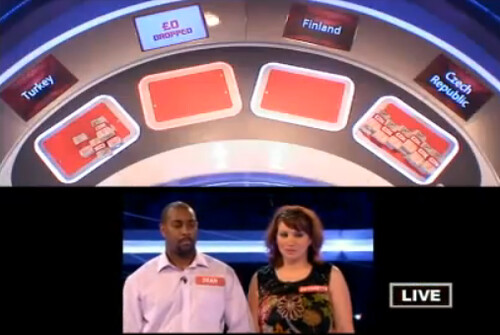
Million Pound Drop


Last night I was absolutely enthralled by the game show Million Pound Drop Live. Game shows aren't usually my thing, but this was just so full of behavioural economics I could not help but be glued to it.

I could probably write  dozens of blogs about various aspects of the game, but today I'll focus on the contestants attitude towards risk.

The show design is simple: the pair of contestants start off with £1m and have to answer 8 questions correctly to win. The twist is that the contestants choose which of the potential answers they want to stake their money on. The incorrect answers are trapdoors - the money placed on these drop away. The correct answer does not drop - the money placed here is kept for the next round. Thus contestants can split their money between answers if they are not sure: they can spread the risk.


It was incredibly interesting watching yesterday's show as the contestants were highly risk averse. They always split their money, regardless of how sure they were of the answer. Even when the were certain they still put some of their money on other options. The end result was that if they'd put all the money on the answer they thought was correct (when they were certain) they would have come out with a lot more than their eventual prize of £150,000 (which is apparently relatively high compared to others).


There are few better examples of risk aversion than watching the contestants on Million Pound Drop, but perhaps why it was so obvious was that as we were playing along at home we never split our money between options. We were risk preferring because we were not playing with real money, I dare say that put me on the show and I would be as risk averse as anyone else. When it is our money it is harder to avoid risk.

PS A few of my sums for you:

If you were to always put 90% of your money on the correct answer you would end up winning £430,467

If you were to always put 75% of your money on the correct answer you would end up winning £100,113

If you were to always put 50% of your money on the correct answer you would end up winning £3,906

(these calculations ignore the fact that the money is bundled up into packets of £25k)

Thursday, 14 June 2012

Mattress Money - Hakuna Matata?

A recent BBC article highlighted the growing trend among Greeks to withdraw their money from banks and, presumably, put it under their mattresses. With confidence in their currency fading fast one can understand why the Greek populous are voting with their money, so to speak. This is an example of risk averse behaviour.

We all have different attitudes towards risk. Some are risk preferring, some risk neutral and some risk averse.

If you had the following choice, which of the two options would you choose?

  • A 50% chance of getting £100
  • A 100% chance of getting £40


I would hope it would be obvious that the first option has a higher expected value (0.5 times 100 is 50). Despite this, many of us (me included) would choose the certain £40. This is called risk averse behaviour. In our minds the 50% risk of getting nothing is not worth taking.

The Greeks who are withdrawing their cash from banks are exhibiting risk averse behaviour. They would clearly prefer to forgo any interest they could earn from their savings, instead making sure that whatever happens at least they have some money.

It's commonly accepted among economists that people are often relatively risk-averse, and thus good economic models account for this type of behaviour. Risk aversion is not bad, indeed, we could do with bankers taking fewer risks at the moment! The level of risk aversion will depend upon the exact situation. For example, if I had already given you £500 before giving you the above choice, you may have been more likely to take the risk (any economists out there will recognise this as the income effect).

In conclusion, mattress money is a prime example of risk aversion. I wonder, if you were Greek right now, would you be happier sleeping on your life savings or entrusting it all to the banks?

Recommended listening:
Hakuna Matata