Showing posts with label rational. Show all posts

Sunday, 26 January 2014

Say no to free stuff

I just turned down free stuff. Free stuff that I want. It was a free subscription to LoveFilm for month. Just think how many films I could watch for free? All those blockbusters... All those shoot-em-ups...

So why turn it down?


So here's the rub. I know I have finite cognitive power (gasp). I tend to forget things. In this case, I'm fairly likely to forget to cancel the LoveFilm subscription at the end of the month. And the penalty for doing so would be the LoveFilm subscription fee for the next month leaving my bank account.

If I was rational and had an infinitely powerful brain I would get the free month's worth of films, then cancel the subscription. But if I was cognitively limited I would get the free month and then forget to cancel it, and thus have to pay for something I think is good but overpriced.

As it happens, I acted in a rational way to counteract my inherent stupidity: I ignored the deal altogether.

So there you go, a prime example of how seemingly irrational behaviour can be explained by people being aware of their limitations.

Tuesday, 9 July 2013

Who Are We Really?


Behavioural economics finds it's significance from the way it reframes the economic perspective of human beings. We are no longer simply called homo economicus. We are allowed to selfless, confused and cooperative.

But that is not entirely satisfactory. The economic paradigm is still in place. We are still primarily consumers. We exist to consume, and consume to exist. We may occasionally give some of our consumption to others, but our primary purpose is unchanged.

There are, as I see it, two main drivers of this consumption complex. Our philosophical leaders (economists and their mindless followers; politicians) who tell us that consumption is everything. And us, who seemingly have an innate drive to get more stuff. More stuff than we had yesterday, more stuff than our neighbours have today.

The problem is that consumption isn't everything. We are more complex than that. Happiness is not just a function of consumption (c.f. friends, family). We cannot be reduced to one-dimensional, consuming robots.

And if that were not enough to make us think twice, limitless consumption is not actually achievable. Our environment has limits. The planet has limits. There are only so many fish in the sea. As Stewart Wallis (of the think tank the new economics foundation) recently said in a TED talk, we need to move on from seeing ourselves as consumers to stewards. Based purely on pragmatism, a serious change in our self-image is needed.


Monday, 8 July 2013

Temptation

The neoclassical economics way of viewing people involves assuming that people are fully capable of making the best decisions for themselves. If a neoclassical economist were to see someone (lets call him Nick) blowing all their savings in a Las Vegas casino he would simply assume that Nick had done all the sums and had concluded that his own personal benefit was maximised by gambling his life savings away.

That may be the case.

But behavioural economists tend to think not.

What if Nick knows what is best for him but chooses not to do it?

What if Nick has finite powers of self-control?


What if Nick hasn't even done the sums properly? He might be aware it's not the best option for him, but not just how disastrous it is.

Behavioural economists use the term 'bounded rationality' to refer to instances where people are clearly less than perfect (often by their own admission). If Nick may overly value short term fun over long term welfare. He knows he's being irrational, but he might need a helping hand to maximise his long term welfare. This is why people are increasingly offered commitment devices - in a rare moment of clear thinking Nick could opt into a scheme which bans him from casinos.

Corporate decision making can also fall foul of self-control issues. A timely example is the over-fishing of EU waters. If politicians really had the long term welfare of fishermen (and of the fish!) in mind then they would restrict the amount of fish that can be caught.


Wednesday, 16 January 2013

Know Your Wage?

I recently heard of a student who had started working part time at a cafe. Three weeks into the job she still did not know how much she was being paid (her first pay day had not yet come). My first thought was "How irrational!"

But then it occurred to me that it might not be as irrational as it first seems.

First, a definition: Your reservation wage is the lowest wage at which you would accept employment.

Now, a law: In the UK you have to be paid at least the minimum wage of £4.98 an hour (aged 18-20).

So, in theory if the student in question had a reservation wage of £4.98 or less, she would not care about what the cafe was paying her, because she knows it has be above her reservation wage by law.

So, she could be rational.


But then, another thought occurred to me: A rational worker would never have a reservation wage below the minimum wage. (Because they know that they could get paid more elsewhere - the lowest wage you would accept would never be lower than what you could get paid elsewhere). Thus a rational worker must have a minimum wage of at least £4.98 an hour.

Conclusion: Either the student has a reservation wage of exactly £4.98 an hour, or she is irrational.


Epilogue: This analysis assumes she is able to get a job elsewhere at the minimum wage. This analysis also assumes money to the only motivator for working. We assume her primary reason she is working is the wage, not the ambience of the cafe, for example.

Thursday, 10 January 2013

Risky risky...

I am about to toss a fair coin. If heads you win £100. If tails you lose £100.

Do you want to play this gamble?


If yes, then you are risk-preferring.

If no, then you are risk-averse.

If you are indifferent, then you are risk-neutral.

That is because the expected value of the gamble is £0 (100x0.5 + -100x0.5 = 0).

Personally I would not like this gamble, which makes me risk averse. The extent of my risk averseness would have to be revealed by considering different gambles, but as long as I am consistent in my attitude to risk an economist could call me rational.

Here are a copuple of other interesting gambles which may shed light on your attitude to risk:

I am about to toss a fair coin. If heads you win £100. If tails you lose £75. Do you want to play?

I am about to toss a fair coin. If heads you win £1000. If tails you lose £50. Do you want to play?

If you would not like to play these gambles then you highly risk averse... Personally I think I would probably play both, definitely the latter one.

Wednesday, 9 January 2013

Russian Roulette

Scenario 1: There is a gun pointed at your head. It has six chambers. There are four bullets inside. The chambers will be spun randomly before the gun is fired once.

Scenario 2: There is a gun pointed at your head. It has six chambers. There is only one bullet inside. The chambers will be spun randomly before the gun is fired once.

In which scenario would you be willing to pay more to have one bullet removed from the chambers?


Interestingly, according to economic theory you should be willing to pay more to reduce the bullets from 4 to 3 than from 1 to 0. Is this the case for you?


For those who are economically inclined, here is a brief sketch of the proof of the theory:

Where u(.) is a von Neumann-Morgenstern utility function, p1 is what you are willing to pay in Scenario 1, p2 is what you are willing to pay in Scenario 2 and Y is your income.

In Scenario 2:
u(alive, Y - p2) = 1/6u(dead) + 5/6u(alive, Y)
In Scenario 1:
1/2u(dead) + 1/2u(alive, Y - p1) = 2/3u(dead) + 1/3u(alive, Y)
Re-write Scenario 1:
u(alive, Y - p1) = 2/6u(dead) + 2/3u(alive, Y)
Comparing scenarios:
u(alive, Y - p2) > u(alive, Y - p1)
Therefore:
p1 > p2
QED

Tuesday, 11 December 2012

When The Chips Are Down...

Last night I played poker. Not for money, just pride. I actually did quite well (cue comments about behavioural economists being able to read people - not actually true; I just got lucky!)

But I was, sadly, irrational.


When I bet my chips, I preferred to bet the smaller chips in larger quantities than the larger chips. For example, I'd bet two 500 chips rather than one 1000 chip. Not only this, but I felt more carefree when I had lots of smaller chips. I would bet on things that I definitely wouldn't have done had I had to get change from a large chip.

I sometimes refused to make bets because it would mean sacrificing a sacred 1000 chip, whereas if I had ten 100 chips I would have bet. Irrational. 

In other words, I changed my behaviour based on trivial things. Trivial things that economists assume we pay no heed of.

Tuesday, 27 November 2012

Book Review - Prisoner's Dilemma


What links the H-bomb, playing chicken and the Cuban missile crisis to game theory?

The answer, according to William Poundstone, is the famous game called the prisoner's dilemma (see here for a fun example). His 1992 book Prisoner's Dilemma is not recent (I was a toddler back then) but is still both fascinating and relevant.

Poundstone's approach is to carefully weave together a biography of John von Neumann and a potted history of the nuclear arms race with examples of fun games. The end result is an utterly gripping read (between you and me I read it in lectures) that never fails to surprise (whether you be an economist or normal).

So as not to ruin the book I'll only share one example of H-bomb game theory...

First, read this fun example of a brilliant game to play with your friends.

Now, the 'Dollar Game' is special because it induces buyers regret. Those who bid inevitably wish they hadn't! There is a rapid escalation. Before we know it, both bidders are wishing they were back where they started. But they always have an incentive to go one higher. They do not want to be left in second place. This is not dissimilar to the nuclear arms race.

The analogy starts with America building the A-bomb at the end of WWII. Understandably, Russia could not contemplate being out gunned so they got one. So the USA understandably got more A-bombs. So did the USSR. So America built the H-bomb. So Russia did too. And so on. The starting position led to escalation and both states ended up in a worse position than at the start when neither had any nuclear bombs: They had spent a lot of money on no tactical advantage. If they had coordinated they could have stopped at some point (i.e. just having one A-bomb each). Sadly for both nations this was never likely to happen.

In fact, the more Poundstone delves into the cold war the more analogies crop up. Coincidently (or not) the people who originally created game theory, such as John von Neumann, also created the bomb.

I highly recommend you read Prisoner's Dilemma so that (if nothing else) you can start to see real life conundrums through game theory spectacles, and what spectacles!


Genre: Economics/Behavioural Economics
Accessibility: 10/10
Accuracy: 9/10
Readability: 9/10
Usefulness: 7/10
Verdict: Very, very interesting!

Monday, 1 October 2012

Turn it up to 11

A problem for economists who think that people are rational is that we are sometimes influenced by things that we really shouldn't be. Much thanks to the friend who recently showed me this clip from the comedy Spinal Tap which parodies human irrationality:


Thursday, 6 September 2012

Tesco Nappies


Own brand products are ubiquitous in supermarkets. Why are they there? How do the supermarkets convince us to buy them?

As I walked around Tesco earlier today I noticed the huge similarity between Tesco own brand goods and branded items (made by a separate supplier).

Let's take the example of nappies. Here Pampers (owned by Proctor and Gamble) is the leading brand. They occupied about 60% of the shelf space in the nappy category. Approximately 20% were Huggies and a further 20% were own brand; Tesco. (This is a rough guide of market share).

The first question is why were Tesco competing with P&G in the nappy market anyway?

The answer lies in the profit margin. By selling their own goods, supermarkets cut out the middleman. They make more money selling their own brand goods than branded ones. However, each individual product space, or 'facing', is at a premium. The rate of sale is important. This leads us onto the second question.

How does Tesco convince us to buy their own brand products?

When an own brand product is in direct competition with a branded one, like the nappies pictured, the supermarket will try to convince us that their (usually) cheaper product does "just as good a job". It uses tricks such as the following to promote similarity between the different products:

  • Placement. Own brand goods are often placed right next to branded ones, and often in the best position ("eye-level is buy-level").
  • Colour. The pictures of the nappies above are a textbook example of a supermarket copying the colour of the market leader. Colour is of huge importance in our brains, and colour schemes are nicked wholesale from the branded goods.
  • Emotional intent. There is a picture of a smiling baby on every pack of nappies in the store (the one exception is a line of uber-cheap Tesco nappies, occupying a tiny section of the bottom shelf).
  • General aspects of design. For example, the number of nappies is on the bottom right corner.
  • Packaging. Both types of nappies come in similar plastic packaging, and are of similar size.

Thus supermarkets use psychology and behavioural economics in an attempt to persuade that their product is just as good.

Does that make us fools for buying own brand goods??

No. Well, not necessarily. The own brand stuff may genuinely be just as good, or even better. Remember, branded goods are constantly trying to keep you loyal. They do not like it when you try out the competitors - they might be better!

Conclusion?

Be rational.

Realistic conclusion?

At least try to be aware of what shops and suppliers are trying to make you feel, think and do.

How??

Know some behavioural economics!

Wednesday, 15 August 2012

You've Been Framed! - American Idiot


  • You are ill in hospital. The surgeon informs you that he could operate. If successful the operation will cure you completely. He tells you that 95% of patients survive the operation.

What do you decide?


  • You are ill in hospital. The surgeon informs you that he could operate. If successful the operation will cure you completely. He tells you that 5% of patients do not survive the operation.

How about now?

Standard economics has always assumed that people's preferences are stable. Thus the way in which questions are worded should not have an impact on what we prefer. Psychologists beg to differ.

Now, you're probably telling yourself that you're unaffected by the way the question is 'framed'. However, evidence shows that people are highly susceptible to framing effects.

More worryingly, evidence shows that doctors are equally susceptible to framing when faced with similar problems to the one above!

We are all to some extent irrational when it comes to framing effects. But never fear, there is an easy way to improve your rationality - simply reframe the problem and see if it changes your preference...

If told:

  • 30 people die out of every 10,000 that undergo an operation

remind yourself that

  • 99.7% survive

Remembering this should help you improve your decision making... Simples!

Recommended listening:
American Idiot by Green Day


Wednesday, 8 August 2012

Sailing Times - I'm A Harrier And I'm Okay


At the start of a week's sailing on the beautiful Norfolk Broads, a question occurred to me... are we rational with regards to time?

I was a leader on Harriers B - a fantastic camp for 15-18s. On the first evening on the cruise, when commanded by the Commodore, we all changed our watches to something called cruise time. Cruise time is an hour later, so at 21:45 all our time-keeping devices were changed to 22:45. The rationale behind it is that as a small fleet of yachts we need to get into moorings early each day while there is still space. So cruise time helps us be earlier. For example, we get up at 7am cruise time and are usually moored up by 5pm cruise time. This sounds a lot better than getting up at 6am every day to be in by 4pm. And because it sounds better it feels better. And because it feels better we do more at that ungodly hour of the morning. Thus cruise time works. It genuinely makes us earlier.


Admittedly there was some protest this year from one of the leaders...

Commy: I'll wake you all up at 7am tomorrow...
Matt: It's 6am!
Commy: No it's not!
Matt: You can't fool my body!

(And in fairness Matt did his very best to prove this was the case throughout the week, never knowingly getting up).

However, most of us swiftly adjusted to cruise time. We were probably better at getting up in the  morning in the mindset of it being 7am than 6am, even though it was all a trick.

According to traditional economics we, as homo economicus, should be unaffected by cruise time. We should behave just the same. It is just a simple trick - the real world time is unaffected. We are not deceived into changing our watches, we all know what we're doing and why we're doing it.


But given that we do change our behaviour when we're told that it's 7am not 6am, even when we know that is not the case, I suggest that this presents a challenge to the belief that we're all the perfectly rational homo economicus.

Recommended listening:
I'm A Harrier And I'm Okay (see verse 5)

Friday, 11 May 2012

Mood Matters – Feeling Good

http://www.techno-lovers.com/wp-content/uploads/2012/05/Samsung-Patented-Emoticon.gif


A recent Facebook conversation got me thinking.

My friend had just done the Common Ratio Effect experiment (see previous blog: Are You Consistent? - Mad World), and was pleased that she had been consistent. However in relation to her answers, she noted that:

“lol... depends on circumstances...”

Which is true. Our answers one minute may vary wildly from the next minute. One day we may be feeling positive and more prone to taking risks, another day we may be more conservative and risk-averse. 

So, therefore, aren’t experiments a load of rubbish? Surely they can’t capture human behaviour accurately, because human behaviour is inherently dependent on our mood?

However, economists solve this problem by repeating the experiments on lots and lots of people (and use different experiments to see if phenomena are ‘robust’). Thus any mood variability should balance out over large populations. And remember, economists test to see if an aspect of behaviour can be shown to be systematic among us humans which does not usually require literally everyone to exhibit it. Anomalies are allowed. It does not matter if you answer differently according to how you feel because an experiment will never rely on your answers alone.

There are other criticisms of experiments (which will have to wait for another blog), but the “it all depends on how I feel” objection, while being absolutely correct, does not actually challenge the validity of experiments.

Recommended listening:
Feeling Good by Nina Simone

Thursday, 10 May 2012

Are You Consistent? - Mad World

Let’s do an experiment to see whether your preferences comply with traditional economic theories. 
 
There are two choices to make; neither affects the other in any way.

Choice 1:

Payoff
Probability of getting Payoff (if not get nothing)
A
£5,000
100%
B
£7,000
60%

Which would you prefer, A or B?

Choice 2:

Payoff
Probability of getting Payoff (if not get nothing)
C
£5,000
25%
D
£7,000
15%

Which would you prefer, C or D?

People commonly choose A and D (I did this too). However, this is inconsistent with traditional economic assumptions about how people behave.

This is because we can easily ‘scale-down’ Choice 1 to make it Choice 2 without changing the relative probabilities. 100 and 60 divided by 4 equal 25 and 15, respectively. Given that Choice 1 and Choice 2 are the same in relative terms economists say that to choose A and D is inconsistent .

It is assumed that any common components of gambles are irrelevant for preferences over the gambles. This is called The Common Ratio Effect (after Mr Common Ratio, presumably).

An important area of Behavioural Economics is discovering where we don’t comply with traditional assumptions about economic agents. The hard bit is incorporating our little foibles into the rest of economics.

https://blogger.googleusercontent.com/img/b/R29vZ2xl/AVvXsEgaPEba0uJH1cRQsm6p8GZJ0ll6kmYkZeJwIJtKf-lC_tBBrJx4LmOo43t5aOcgfwubLvrQzQoXJxpTc3v9txqXkYhqcAJS005-87B_oW3Jh1gi-gticm2GzXmjrZtVCGAP_JtATUgvl9LF/s1600/Bush+confused+a+little.jpg

Recommended listening:
Mad World by Gary Jules

Friday, 4 May 2012

Preference Reversal – I Need A Dollar

As we discovered last time, for traditional economics relies upon economic agents being consistent and thus rational. Today we will uncover a common phenomenon: preference reversal.


Let’s start with a little experiment...


You have a choice. There are two options of differing payoff and probability. Imagine that you, the subject, will get to keep any payoff you get. I, the experimenter, will pick a ball at random from a bag (a la bingo) to decide whether you are awarded any payoff. If you choose Option A I will use a set of balls that give you a 70% chance of getting the payoff (of £24), if you choose Option B I will use a set of balls that give you a 25% chance of getting the payoff (of £80).


Probability
Payoff
Option A
0.7
£24
Option B
0.25
£80


  • If you had to choose between them, which option would you rather have?

  • Now think about how much each option is worth to you: what amount of money would be of equal value as each option? (What would you deem a fair price for each option to be?)


If you’re anything like me you will have chosen Option A. You may also have valued Option A at something like £17 and Option B at around £20. 


And if you did, you were irrational. 


Why? Because you said you prefer the Option A in the straight choice, but value Option B higher. This is inconsistent. We can infer that you both prefer Option A and Option B (because you valued it at a greater sum of money). You have ‘reversed’ your preferences. This is ‘standard preference reversal’ (‘non-standard’ is where someone chooses Option B, but values Option A higher). PR is asymmetric; the overwhelming majority of preference reversals are the standard type.


If you were inconsistent, don’t worry, you are not alone. If you were consistent you are probably smug, well done. 


Preference reversal (PR) is the phenomenon where individuals change what they say they prefer, purely because the way they were asked was different. Interestingly, people change their preferences in a highly predictable, yet irrational, way. 


The psychologists Lichtenstein and Slovic (1971) first demonstrated PR using their, now famous, experiment design (as roughly replicated above). They called Option A the ‘P-bet’ and Option B the ‘$-bet’.


The first economists to take notice of PR were David Grether and Charles Plott in 1979. They set out to ‘discredit’ the psychologists findings. They failed. Badly. After testing 13 theories they were forced to conclude that PR was not caused by flawed research. My favourite of their theories include:


Theory 12: The original experiments were done on psychology students who are ‘unsophisticated subjects’.


Theory 13: The original experiments were done by psychologists ‘who have a reputation for deceiving subjects’


Alas, it turns out that PR is real and here to stay. We will explore the causes of PR in later blogs, but the debate is basically between economists and psychologists over whether it is inherently daft to assume that people have underlying preferences. Psychologists argue that we only ‘construct’ preferences when we face decisions, while economists argue that our preferences already exist and we just refer to them.


I will finish by giving an example of PR in the real world (controversial, I know)...


http://static.guim.co.uk/sys-images/Guardian/Pix/pictures/2012/1/31/1328027920111/high-speed-train-Eurostar-007.jpg


Imagine you own a sheep farm in the Chiltons. However, the Government wants to build a high-speed rail link right through your land. The new line can either go straight past your delightful little cottage (causing you a big headache), or it can take a longer route going through your fields (taking up more of your prime sheep farming land). The Government wants to know which route you’d prefer. They can either ask you which option you would chose in a straight choice, or they can ask you how much compensation you will demand for each option (and choose the cheapest). Governments worldwide use both methods of asking people all the time, assuming they yield the same preference. 


PR would suggest that they might not...


Recommended listening:
I Need A Dollar by Aloe Blacc

Thursday, 3 May 2012

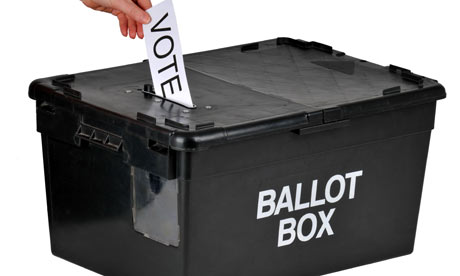
Why Bother Voting? – Sunny Afternoon

Today is polling day in the UK, millions will be voting in local elections and referenda. The French are currently voting for their next president and Americans will be doing likewise in the autumn. 

But on an individual level, why do we all bother?

caphttp://static.guim.co.uk/sys-images/Guardian/About/General/2010/4/2/1270211485928/A-ballot-box-001.jpg

We tend to do stuff (in life generally) if the expected benefits outweigh the expected costs. But the expected benefits of voting are basically zero, and the costs aren’t negligible. Your benefit from voting depends on whether your vote influences the outcome of the election. We can crudely estimate your benefit from voting by multiplying the probability that your vote will change the election outcome by the benefit you would gain from your preferred candidate winning. But the probability of you being the decisive voter is TINY (even in marginal constituencies). Thus the benefit from voting is negligible.

Given that there will be a cost to you of voting (taking time to think about policies and go to the polling station etc) we can rightly pose the question: why do we, rational, intelligent human beings, bother voting?

“The rationality of voting is the Achilles’ heel of rational choice theory” (Aldrich, 1997)

Many have attempted to answer that question by adding another ingredient into the mix: the direct benefit to you from voting, irrespective of who wins. This solves the puzzle. Or does it? Without adequately explaining exactly what this direct benefit is and what causes it, all we have is a typical economics fudge.

Some have suggested that the direct benefit is the knowledge that we are fulfilling our civic duty, or that we value being able to voice our opinions, even if it won’t change the election outcome.

One economist, Patricia Funk (2010), thought that the social pressure to vote might have an impact. She analysed the effect of introducing postal voting in Switzerland. Postal voting reduces the social pressure to vote (as you do not have to be seen down the polling station by your community). If this hypothesis is correct then we would expect to see the absence of postal voting lowering turnout in small communities more than in large ones (as everybody knows everybody in a small village etc). This is what she observed. However, there has to be more to puzzle than social pressure, as most people still voted using postal votes.

I will be voting later this evening, and I encourage all you (who can) to do so too. Personally, I think the civic duty suggestion is most accurate but I would be interested to hear your thoughts.

So, why did you/will you vote today?

Social pressure, civic duty or something else? 

Please leave a comment...


Recommended listening:
Sunny Afternoon by The Kinks

Wednesday, 2 May 2012

Behavioural Economics – What A Wonderful World

Welcome to the world of Behavioural Economics: where Economics meets Psychology and stays for nice little chat, taking a comfy seat by the warming fireside of experimental evidence, holding a hot mug of pure rationality. Hmmm... rationality. The oil that makes the world go round.

Or does it?

Behavioural Economics is the area of study devoted to the exploration of how economic agents (that you and me folks) think, act and react. Put simply: are we rational? Rationality is where people have consistent preferences, and that from any given range of options, people always chose the one they most prefer.

In 1971 two psychologists named Sarah Litchenstein and Paul Slovic stumbled upon a phenomenon that was to rock the economics world: preference reversal. Preference reversal challenges an assumption economists make every day: that economic agents (still talking about you and me) are consistent. If we are not then the cornerstone of microeconomics is compromised.

This is because the accuracy of economic models hinges on whether they are able to predict human behaviour. If we are systemically inconsistent, and thus irrational, economists need to be able to ‘model’ this behaviour. Traditionally, however, economists have circumvented this problem by, well, ignoring it.

Enter stage left, Litchenstein and Slovic. The subject of preference reversal will be my next blog, where we will discover that we are not as logical as we like to think. So for now all we shall note is that it got the attention of economists who, since then, have being trying to define our irrationality and incorporate it into their models.

But why does any of this actually matter?

Because economic models are highly influential. Interest rates, Government spending and taxation are all set according to economic models that are built on the assumption of rationality.

So it’s important, but why should you bother with it?

Because it affects the decisions you make every day: what you say you prefer, what you buy and how much effort you put in at work. Furthermore, companies are starting to wake up to Behavioural Economics and are attempting to use it to manipulate economic agents (still us) to buy their stuff.

You still may not be concerned by that. Which is fine. But then, are you sure you’re rational?


Recommended listening:
What A Wonderful World by Louis Armstrong