Showing posts with label gameshow. Show all posts
Sunday, 7 October 2012
Million Pound Drop
Last night I was absolutely enthralled by the game show Million Pound Drop Live. Game shows aren't usually my thing, but this was just so full of behavioural economics I could not help but be glued to it.
I could probably write dozens of blogs about various aspects of the game, but today I'll focus on the contestants attitude towards risk.
The show design is simple: the pair of contestants start off with £1m and have to answer 8 questions correctly to win. The twist is that the contestants choose which of the potential answers they want to stake their money on. The incorrect answers are trapdoors - the money placed on these drop away. The correct answer does not drop - the money placed here is kept for the next round. Thus contestants can split their money between answers if they are not sure: they can spread the risk.
It was incredibly interesting watching yesterday's show as the contestants were highly risk averse. They always split their money, regardless of how sure they were of the answer. Even when the were certain they still put some of their money on other options. The end result was that if they'd put all the money on the answer they thought was correct (when they were certain) they would have come out with a lot more than their eventual prize of £150,000 (which is apparently relatively high compared to others).
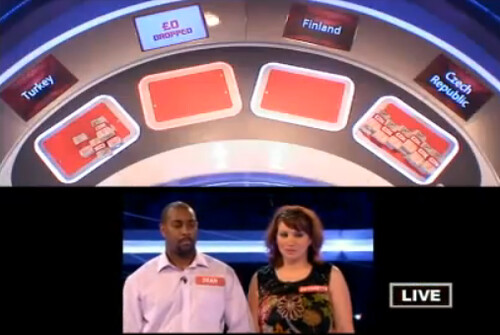
There are few better examples of risk aversion than watching the contestants on Million Pound Drop, but perhaps why it was so obvious was that as we were playing along at home we never split our money between options. We were risk preferring because we were not playing with real money, I dare say that put me on the show and I would be as risk averse as anyone else. When it is our money it is harder to avoid risk.
PS A few of my sums for you:
If you were to always put 90% of your money on the correct answer you would end up winning £430,467
If you were to always put 75% of your money on the correct answer you would end up winning £100,113
If you were to always put 50% of your money on the correct answer you would end up winning £3,906
(these calculations ignore the fact that the money is bundled up into packets of £25k)
Thursday, 19 July 2012
The Monty Hall Problem - Fast Car
This is a probability puzzle named after the American quiz show host Monty Hall. Strictly speaking it's not a behavioural economics puzzle, but I'm interested in what you do...
There are three doors (1, 2 and 3) with one prize hidden behind each one. There is one car and two goats. Obviously, the idea is to get lucky and pick the car. Equally obviously, there is a one third chance of getting the car.
You can pick whichever door you like, for example door 1.
Monty knows where the car is. He has a think. He opens door 3 and reveals a goat.
He then offers you the chance to switch from door 1 to door 2 (or to stick with door 1).
Do you switch from 1 to 2?
When I first faced this problem I said no. I would stick with door 1. I reasoned that now there is a 50% chance of getting it right, and I might as well stick with what I put down first. It turns out that I was wrong.
If you switch to door 2 there is a higher probability of getting the car!
Wikipedia is full of differing explanations for the maths behind it, but I'll explain it in the way I reasoned it out.
At the start of the problem there is a one third chance of picking the car and you pick door 1. Thus there is a two thirds chance that one of doors 2 and 3 have the car. Therefore there is a two thirds chance that when Monty chose the door to open, he had no choice (he could not open the other door as that would have revealed the car).
There is only a one third chance that neither 2 or 3 had the car. In this case Monty could have picked either 2 or 3 to open.
Thus because there is a 2/3 probability that Monty had to open 3 and there is only a 1/3 chance he could have chosen either, we should switch to the one he did not open: door 2.
It took me a long time to work that out. Please let me know whether my explanation is adequate...
Recommended listening:
Fast Car by Tracy Chapman
There are three doors (1, 2 and 3) with one prize hidden behind each one. There is one car and two goats. Obviously, the idea is to get lucky and pick the car. Equally obviously, there is a one third chance of getting the car.
You can pick whichever door you like, for example door 1.
Monty knows where the car is. He has a think. He opens door 3 and reveals a goat.
He then offers you the chance to switch from door 1 to door 2 (or to stick with door 1).
Do you switch from 1 to 2?
When I first faced this problem I said no. I would stick with door 1. I reasoned that now there is a 50% chance of getting it right, and I might as well stick with what I put down first. It turns out that I was wrong.
If you switch to door 2 there is a higher probability of getting the car!
Wikipedia is full of differing explanations for the maths behind it, but I'll explain it in the way I reasoned it out.
At the start of the problem there is a one third chance of picking the car and you pick door 1. Thus there is a two thirds chance that one of doors 2 and 3 have the car. Therefore there is a two thirds chance that when Monty chose the door to open, he had no choice (he could not open the other door as that would have revealed the car).
There is only a one third chance that neither 2 or 3 had the car. In this case Monty could have picked either 2 or 3 to open.
Thus because there is a 2/3 probability that Monty had to open 3 and there is only a 1/3 chance he could have chosen either, we should switch to the one he did not open: door 2.
It took me a long time to work that out. Please let me know whether my explanation is adequate...
Recommended listening:
Fast Car by Tracy Chapman
Subscribe to:
Posts (Atom)


