Showing posts with label conventions. Show all posts
Wednesday, 8 August 2012
Sailing Times - I'm A Harrier And I'm Okay
At the start of a week's sailing on the beautiful Norfolk Broads, a question occurred to me... are we rational with regards to time?
I was a leader on Harriers B - a fantastic camp for 15-18s. On the first evening on the cruise, when commanded by the Commodore, we all changed our watches to something called cruise time. Cruise time is an hour later, so at 21:45 all our time-keeping devices were changed to 22:45. The rationale behind it is that as a small fleet of yachts we need to get into moorings early each day while there is still space. So cruise time helps us be earlier. For example, we get up at 7am cruise time and are usually moored up by 5pm cruise time. This sounds a lot better than getting up at 6am every day to be in by 4pm. And because it sounds better it feels better. And because it feels better we do more at that ungodly hour of the morning. Thus cruise time works. It genuinely makes us earlier.
Admittedly there was some protest this year from one of the leaders...
Commy: I'll wake you all up at 7am tomorrow...
Matt: It's 6am!
Commy: No it's not!
Matt: You can't fool my body!
(And in fairness Matt did his very best to prove this was the case throughout the week, never knowingly getting up).
However, most of us swiftly adjusted to cruise time. We were probably better at getting up in the morning in the mindset of it being 7am than 6am, even though it was all a trick.
According to traditional economics we, as homo economicus, should be unaffected by cruise time. We should behave just the same. It is just a simple trick - the real world time is unaffected. We are not deceived into changing our watches, we all know what we're doing and why we're doing it.
But given that we do change our behaviour when we're told that it's 7am not 6am, even when we know that is not the case, I suggest that this presents a challenge to the belief that we're all the perfectly rational homo economicus.
Recommended listening:
I'm A Harrier And I'm Okay (see verse 5)
Friday, 20 July 2012
Game Theory - Steal Away
Game Theory is one of those things almost all of us have heard of but very few have been able to learn about. It's hugely important in economics, especially the behavioural side of things. So, here is a very brief introduction to Game Theory...
Here is a typical two player 'game':
Both players decide simultaneously, and without communication, what course of action to take in regards to a strawberry milkshake. They can either share it or steal it. The table shows the four possible outcomes, with the numbers representing what economists call 'utility' (the net benefit to each player).
The fair outcome is (Share, Share) as both get a utility of 2, but both players have an incentive to steal. However, if both try to steal it half the milkshake is spilt on the floor.
Imagine you're Player 1... What do you do? What is your strategy?
Economists use something called the Nash Equilibrium to define the likely outcome. A Nash Equilibrium is an outcome where no-one has an incentive to change their strategy. Thus it is stable. We can work out your best strategy as Player 1 by imagining what Player 2 could do.
If Player 2 steals your best response is to steal (as 1 > 0). If Player 2 shares, your best response is to steal (as 4 > 2). Hey presto, you should always steal!
Equivalently, Player 2 should also always steal. Therefore the Nash Equilibrium is (Steal, Steal).
There is clearly a better outcome for everyone involved (which economists call the Pareto-efficient outcome) but economists predict that without coordination it wont be reached.
Of course if we change the numbers we can change the 'game' and thus the outcome. Much more interesting games than this one (which is commonly called the Prisoners' Dilemma) will have to be covered in later blogs.
Recommended listening:
Steal Away by Ozzy Osbourne
Here is a typical two player 'game':
Player
2
|
|||
Steal
|
Share
|
||
Player
1
|
Steal
|
1,1
|
4,0
|
Share
|
0,4
|
2,2
|
|
Both players decide simultaneously, and without communication, what course of action to take in regards to a strawberry milkshake. They can either share it or steal it. The table shows the four possible outcomes, with the numbers representing what economists call 'utility' (the net benefit to each player).
The fair outcome is (Share, Share) as both get a utility of 2, but both players have an incentive to steal. However, if both try to steal it half the milkshake is spilt on the floor.
Imagine you're Player 1... What do you do? What is your strategy?
Economists use something called the Nash Equilibrium to define the likely outcome. A Nash Equilibrium is an outcome where no-one has an incentive to change their strategy. Thus it is stable. We can work out your best strategy as Player 1 by imagining what Player 2 could do.
If Player 2 steals your best response is to steal (as 1 > 0). If Player 2 shares, your best response is to steal (as 4 > 2). Hey presto, you should always steal!
Equivalently, Player 2 should also always steal. Therefore the Nash Equilibrium is (Steal, Steal).
There is clearly a better outcome for everyone involved (which economists call the Pareto-efficient outcome) but economists predict that without coordination it wont be reached.
Of course if we change the numbers we can change the 'game' and thus the outcome. Much more interesting games than this one (which is commonly called the Prisoners' Dilemma) will have to be covered in later blogs.
Recommended listening:
Steal Away by Ozzy Osbourne
Tuesday, 19 June 2012
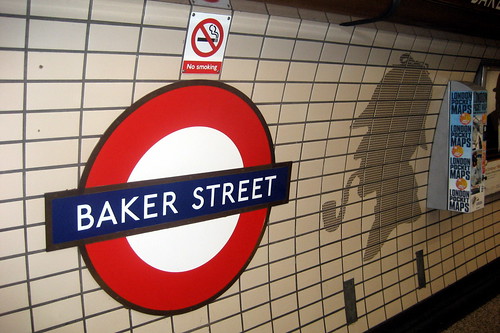
Overtaking On The Tube - Baker Street
Every time I use the London Underground the same thought occurs to me - on the escalators, why do people always overtake on the left?
Why does everyone follow the same rule? How did this rule come into being? On British roads overtaking is done to the right, so why it is different on the Tube?
Rules like this are often called social conventions, or norms. Economists have long been interested in how they come about and what sustains them. Hopefully this will shed some light on the matter.
On escalators there are three possible social conventions. Firstly, overtaking is done to the left. Secondly, overtaking is done to the right. Thirdly, people can stand wherever they wish; overtakers have to weave their way through.
Clearly the third option is inefficient; slowing down the people in a rush. Thus there is a clear advantage to the first two options. However, they are equally efficient; there is no particular advantage to choosing one over the other. So why is the first one in operation?
Once a convention is in place it is easy to see how it will be self-sustaining: one does not benefit by deviating from the rule. But how did the rule come to be chosen in the first place?
It's important to remember that social conventions are not created by everyone sitting down and having a good old chin-wag about what would be most efficient. Rather, they're formed by many individuals doing that which they think (or guess) will benefit them the most in any given context.
The economist Robert Sugden points out that social conventions are often borrowed from other contexts. When it comes to guessing what one should do in a particular situation, we may follow a rule that we've seen working in a different situation. Thus the ease of transferability of a convention is important. But it is not obvious why overtaking on the left is more easily transferred from other contexts.
So I did some detective work...
According to Wikipedia, people were originally told to overtake on the left because the original escalator design made it marginally faster to be on the left hand side: if you were in a rush the left was the place to be. If I'm honest, I can't understand how one side could get you to there faster, but then I'm just a simple economist.
Devastatingly, Wikipedia implies that the overtake on the left rule was introduced by the authorities. If so, it is less of a social convention and more of a top-down law. Luckily, it's only Wikipedia.
Anyway, I hope this thought experiment has been interesting. Please do suggest any alternative explanations for why we overtake on the left...
Recommended listening:
Baker Street by Gerry Rafferty
Subscribe to:
Posts (Atom)